

Pulsation Dampeners
Reduce the pulsating flow of the pump through the use of a gas cushion that reduces pressure spikes, varying flow and pipework vibration.
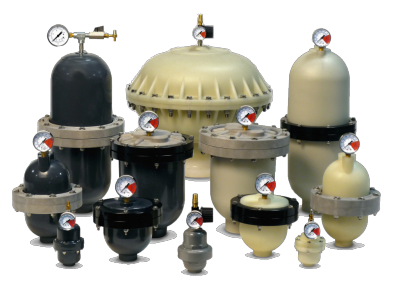
Pulsation Dampeners: Function, Design, and Application
Pulsation dampeners are hydraulic devices designed to absorb pressure fluctuations generated by positive displacement pumps such as piston, diaphragm, plunger, hose, and metering pumps. By reducing pressure pulsations at the source, pulsation dampeners protect piping systems, instrumentation, and pumps while improving flow stability and process accuracy.
Why Pulsation Occurs in Pumping Systems
Positive displacement pumps move fluid in discrete volumes per stroke or revolution, not as a continuous stream. Each displacement event creates a pressure spike, followed by a pressure drop. These pressure waves propagate through the system, causing:
- Pipe vibration and fatigue
- Instrument and sensor damage
- Seal and valve wear
- Inaccurate flow measurement and dosing
- Increased noise and energy losses
Without mitigation, pulsation accelerates system wear and reduces reliability.
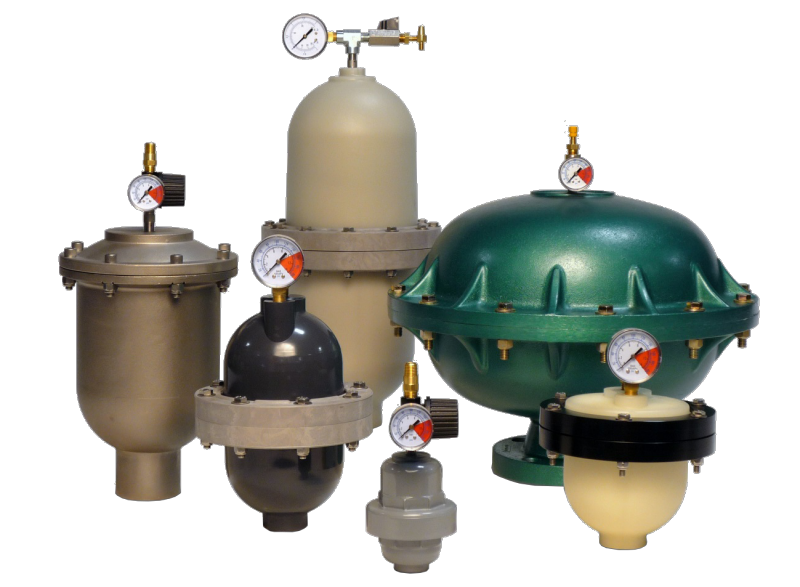
How Pulsation Dampeners Work
A pulsation dampener operates by providing a compressible volume within the hydraulic system that absorbs pressure peaks and releases energy during pressure drops.
Most dampeners consist of:
- A pressure-rated housing
- An internal elastomer bladder, diaphragm, or piston
- A pre-charge gas (typically nitrogen)
Operating Principle
- During a pressure spike, fluid enters the dampener and compresses the gas volume
- The compressed gas absorbs energy and reduces peak pressure
- During pressure decay, the stored energy is released, maintaining system pressure
This results in smoothed flow, stabilised pressure, and reduced mechanical stress.
Types of Pulsation Dampeners
Bladder-Type Dampeners
- High energy absorption efficiency
- Rapid response to pressure spikes
- Ideal for metering and reciprocating pumps
Diaphragm-Type Dampeners
- Compact design
- Suitable for hygienic or low-volume systems
- Lower maintenance requirements
Piston-Type Dampeners
- High-pressure capability
- Suitable for aggressive or high-temperature fluids
Key Technical Benefits
- Pressure pulsation reduction up to 90% or more
- Improved flow meter accuracy and dosing repeatability
- Reduced vibration, noise, and pipe stress
- Extended pump, seal, and valve service life
- Improved energy efficiency and system stability
Correct Dampener Selection
Effective pulsation control requires proper sizing and configuration:
- Pump type and displacement volume
- Operating pressure and pressure variation
- Fluid properties (density, compressibility, temperature, chemical compatibility)
- Stroke frequency or pump speed
- Installation location (suction side, discharge side, or both)
Incorrect sizing or pre-charge pressure significantly reduces performance.
Installation and Maintenance Considerations
- Install dampeners as close to the pump discharge as possible
- Maintain correct gas pre-charge pressure relative to operating pressure
- Periodically inspect bladder or diaphragm condition
- Verify compatibility of wetted materials with process fluid
- Follow pressure vessel safety standards and certification requirements
Applications
Pulsation dampeners are used extensively in:
- Chemical dosing and injection systems
- Water and wastewater treatment
- Oil & gas and energy processing
- Pharmaceutical and hygienic production
- Industrial process pumping
Sizes available for all positive displacement pumps with discharge sizes from 1/8" to 6"
- Pressure ranges up to 11,500 psi (792.8 bar) available from stock Temperature ranges from -60°F to +400°F (-51°C to +205°C) available from stock. Custom models available up to 100 gallons (378.5L) and 25,000 psi (1724 bar)
- Bodies available in a full range of chemically resistant materials.
- Bladders available for even the most corrosive applications.
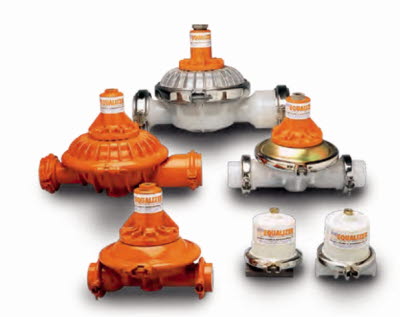
A Pulsation Dampener placed at the pump's discharge will produce a near steady fluid flow up
to 99% pulsation and vibration free.
- Protects pipes, valves, fittings, meters, and in-line instrumentation from destructive pulsations, surges, cavitation, thermal expansion, and water hammer
- Creates steady and continuous flow when dosing, blending or proportioning additives
- Ensures accuracy, longevity, and repeatability of in-line meters
- Enables uniform application of material in spraying and coating systems
- Reduces product agitation, foaming, splashing and degradation of product
- Provides liquid energy storage for emergency valve closure and other equipment shutdown
- Reduces overall energy cost with continuous flow, rather than start/ stop flow
- Operates as a reservoir for make-up fluid
- Simple, reliable design and quick installation
- Easy in-line maintenance
